How Businesses Can Prepare for ZATCA and UAE Electronic Invoicing
Businesses across the Gulf are moving from traditional invoicing to structured electronic invoicing.
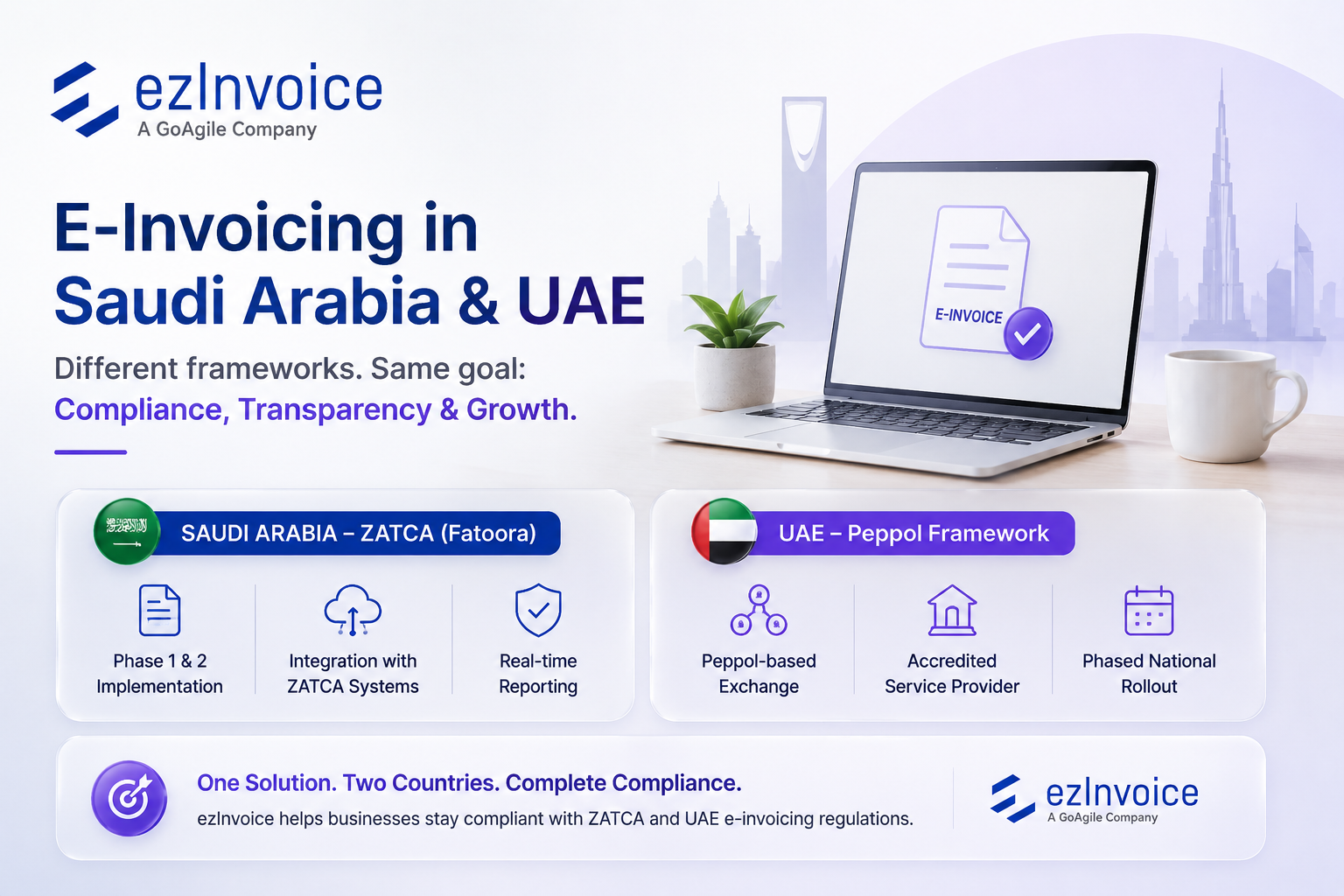
Saudi Arabia and the United Arab Emirates are both implementing national e-invoicing frameworks, but their technical requirements, integration models, and implementation timelines differ.
For businesses operating in both markets, choosing an e-invoicing solution that can integrate with existing ERP, accounting, POS, and business applications can make the transition significantly easier.
What Is E-Invoicing?
E-invoicing is more than converting a paper invoice into a PDF.
A true electronic invoice contains structured invoice data that can be exchanged and processed electronically between businesses and tax authorities or designated platforms.
This allows invoice information to be:
- Validated
- Exchanged
- Reported
- Stored
- Processed in a standardized format
The UAE Ministry of Finance specifically states that PDFs, scanned documents, images, Word files, and invoices sent by email are not considered electronic invoices under the UAE framework.
This distinction is important for businesses planning their technology strategy.
Saudi Arabia: ZATCA E-Invoicing and Fatoora
Saudi Arabia's e-invoicing programme is administered by the Zakat, Tax and Customs Authority (ZATCA) through the Fatoora platform.
The Saudi programme has two main phases.
Phase 1 Generation Phase
Phase 1 began on 4 December 2021 and requires taxpayers subject to the e-invoicing regulations to generate and store invoices electronically using a compliant solution.
Phase 2 Integration Phase
Phase 2 began on 1 January 2023 and is being introduced in waves.
Businesses selected for Phase 2 must integrate their electronic invoicing solution with ZATCA's systems and generate invoices according to the required technical specifications.
ZATCA's latest Wave 25 announcement, dated 24 July 2026, states that taxpayers whose VAT-subject revenue exceeded SAR 187,500 during 2022, 2023, 2024, or 2025 are included in the selection criteria.
ZATCA will notify the targeted taxpayers, who must integrate with Fatoora no later than 1 February 2027.
For businesses in Saudi Arabia, this means e-invoicing is no longer simply an accounting feature.
The invoicing system must be capable of meeting ZATCA's technical and integration requirements.
UAE: Electronic Invoicing and Peppol
The UAE is following a different electronic invoicing model.
The UAE Ministry of Finance has adopted the international OpenPeppol standard as the foundation for its electronic invoicing framework.
The system is designed to enable structured electronic invoice exchange and reporting between businesses and government entities.
The UAE framework is being introduced in stages.
According to the official Ministry of Finance timeline:
- 1 July 2026: Pilot programme began
- 1 January 2027: Businesses with annual revenue of AED 50 million or more must implement electronic invoicing
- 1 July 2027: Businesses below AED 50 million must implement electronic invoicing
- 1 October 2027: In-scope government entities must implement electronic invoicing
The Ministry also extended the deadline for businesses with annual revenue above AED 50 million to appoint an Accredited Service Provider from 31 July 2026 to 30 October 2026.
This makes UAE e-invoicing preparation an immediate technology and compliance priority for affected businesses.
ZATCA vs UAE E-Invoicing: What's the Difference?
Although both countries are moving toward structured digital invoicing, businesses should not assume that one country's implementation can simply be copied to the other.
| Area | Saudi Arabia | UAE |
|---|---|---|
| Authority | ZATCA | UAE Ministry of Finance / FTA framework |
| National platform / framework | Fatoora | Peppol-based framework |
| Implementation | Phase 1 and Phase 2 waves | Phased national rollout |
| Integration | Integration with ZATCA systems | Accredited Service Provider and Peppol-based exchange |
| Current focus | ZATCA Phase 2 integration | Preparation for mandatory rollout |
| Key technology consideration | ZATCA technical requirements | Peppol and ASP connectivity |
The underlying business challenge is similar:
Companies need invoicing systems that can produce structured electronic invoice data and exchange it through the required technical channels.
Do You Need to Replace Your ERP?
In most cases, businesses should first evaluate integration rather than replacement.
Companies may already generate invoices through:
- SAP
- Oracle
- Microsoft Dynamics
- Odoo
- POS systems
- Accounting software
- E-commerce platforms
- Custom-built applications
An e-invoicing platform can act as the integration layer between these existing systems and the applicable national framework.
For Saudi Arabia, this can mean connecting the existing invoicing workflow with ZATCA's Fatoora requirements.
For the UAE, businesses need to consider the country's Peppol-based electronic invoicing architecture and the role of an Accredited Service Provider.
The right approach depends on the company's:
- ERP
- Invoice volume
- Business model
- Country of operation
- Existing technology
- Integration requirements
How ezInvoice Helps Businesses
ezInvoice provides a cloud-based e-invoicing platform and API integration capabilities designed to help businesses move from manual or disconnected invoicing processes to automated electronic invoicing.
Businesses can use the web-based platform to create and manage invoices, or connect their existing applications through APIs.
This allows organizations to choose an approach based on their existing technology.
For Businesses in Saudi Arabia, ezInvoice supports ZATCA-focused e-invoicing workflows, including integration with existing business systems and the technical requirements associated with the Saudi e-invoicing framework.
- Businesses can connect:
- ERP systems
- POS systems
- Accounting applications
- Custom applications
Instead of rebuilding their entire invoicing infrastructure.
For Businesses in the UAE, ezInvoice is designed to support businesses preparing for the UAE's electronic invoicing transition and the structured data and integration requirements associated with the country's Peppol-based framework.
Businesses operating across Saudi Arabia and the UAE can therefore work toward a regional invoicing strategy while keeping local regulatory requirements in consideration.
One Platform, Different E-Invoicing Requirements
The future of business invoicing in the Gulf is increasingly digital, but compliance is not identical across every country.
Saudi Arabia has its ZATCA Fatoora framework and phased integration requirements.
The UAE is implementing a Peppol-based electronic invoicing framework with Accredited Service Providers and phased mandatory implementation.
For companies operating across both markets, the goal should be to build an invoicing architecture flexible enough to support different regulatory environments.
That is where an API-enabled platform can provide an advantage.
Instead of replacing your ERP, you can connect your existing systems to an e-invoicing layer and adapt the integration according to the market in which you operate.
Frequently Asked Questions
What is the difference between ZATCA e-invoicing and UAE e-invoicing?
ZATCA e-invoicing is Saudi Arabia's national e-invoicing framework, implemented through Phase 1 and Phase 2, with Phase 2 requiring integration with ZATCA systems.
The UAE is implementing a separate electronic invoicing framework based on the OpenPeppol standard and Accredited Service Providers.
Is a PDF invoice considered an e-invoice in the UAE?
No, The UAE Ministry of Finance states that unstructured formats such as PDFs, Word documents, images, scanned invoices, and invoices sent by email are not electronic invoices under the UAE framework.
Do Saudi businesses need to replace their ERP for ZATCA e-invoicing?
Not necessarily. businesses can integrate their existing ERP, POS, accounting, or custom applications with a compliant e-invoicing solution, provided the resulting setup meets the applicable ZATCA requirements.
ZATCA's guidance confirms that taxpayers can use their existing Phase 1 solution by updating it to meet Phase 2 requirements.
When does UAE mandatory e-invoicing start?
The UAE implementation is phased.
- Businesses with annual revenue of AED 50 million or more: 1 January 2027
- Businesses with annual revenue below AED 50 million: 1 July 2027
When is the ZATCA Wave 25 deadline?
For taxpayers notified as part of ZATCA Wave 25, the integration deadline is 1 February 2027.
The Wave 25 selection criterion announced by ZATCA is VAT-subject revenue exceeding SAR 187,500 during 2022, 2023, 2024, or 2025.
Prepare for Regional E-Invoicing With ezInvoice
Whether your business operates in Saudi Arabia, the UAE, or across multiple Gulf markets, e-invoicing should be treated as an integration project not simply an invoice-format change.
ezInvoice provides businesses with a cloud-based invoicing platform and API integration capabilities to connect their existing business systems with modern electronic invoicing workflows.
For Saudi businesses, that means preparing for ZATCA and Fatoora requirements.
For UAE businesses, it means preparing for the country's Peppol-based electronic invoicing framework and upcoming mandatory rollout.
The earlier your business evaluates its:
ERP
Accounting system
Invoice data
Integration architecture
E-invoicing provider
…the easier the transition can be.
Ready to evaluate your e-invoicing setup?
Explore ezInvoice and see how your existing invoicing workflow can be connected to a modern electronic invoicing platform.